
Where to Buy Pokémon Card Dividers for Binders
Last Updated: October 24, 2026
Quick Summary
Buy card dividers from online card shops, marketplaces, local game shops, or craft stores, and choose printable files if you need custom labels. Online card shops are the strongest starting point because they list dimensions and stock supplies alongside singles. Always confirm height and width in millimetres before buying.
- Local game shops let you test tab clearance with a pocket page before buying.
- Printable dividers suit vintage sets and custom sections where pre-made labels don't exist.
- A pack labeled all sets often covers recent releases only, so check the set list by name.
- Rigid plastic dividers with rounded edges slide past sleeved cards without snagging.
- Too many dividers plus too many cards bows the binder spine and presses on pages.
Table of Contents
- Where to Buy Pokémon Card Dividers for Binders: The Options
- Pokémon TCG Binder Dividers: Physical vs Printable
- Custom Pokémon Card Dividers: What to Look For
- Trading Card Binder Dividers: Fit, Material, and Card Safety
- Pokémon Card Binder Organization: Sorting by Set and Rarity
- Dividers by Pokémon Set: Covering Current and Older Releases
- Common Mistakes When Buying and Using Card Dividers
- Conclusion
- Frequently Asked Questions
Where to Buy Pokémon Card Dividers for Binders: The Options
If you've ever flipped through a binder hunting one card and given up, you understand why card dividers matter.
The core problem: dividers are cheap, so people buy carelessly, then discover the tabs don't clear the pocket pages or the plastic drags a foil card along with it.
Below, we walk through every buying channel, compare physical and printable options, and cover the fit and material details that decide whether a divider protects your cards.
Online Card Shops and Specialty Retailers
Specialty card shops are the strongest starting point. They stock supplies alongside singles and sealed product, so you can match divider quantity and style to your binder, and most list dimensions on the product page.
If you're also weighing where to buy sealed Pokémon products safely from online shops, read a full breakdown of buying sealed Pokémon products online first.
A common mistake is buying dividers from a listing with no measurements. If the page doesn't state height and width in millimetres, assume nothing and ask.
Marketplaces, Craft Stores, and Local Game Shops
Marketplaces offer the widest range and the widest quality gap, from thin cardstock separators to rigid plastic dividers, and listings rarely distinguish between them.
Local game shops let you physically hold the divider before buying.
Craft stores stock generic divider blanks that work in a pinch, particularly for three-ring binders. They're rarely cut to trading card height, so expect to trim them.
| Buying Channel | Best For | Watch Out For |
|---|---|---|
| Online card shops | Verified dimensions, supply bundles | Shipping thresholds |
| Marketplaces | Widest range, bulk quantity | Vague material listings |
| Local game shops | Hands-on fit testing | Limited stock depth |
| Craft stores | Generic blanks, quick fixes | Wrong height, needs trimming |
Pokémon TCG Binder Dividers: Physical vs Printable
Physical dividers arrive cut, tabbed, and ready to slot in. Printable files are digital downloads you print and cut yourself. Both work; the choice comes down to quantity, customization, and time spent with a cutting mat. Here's the practical cost and effort breakdown.
Physical Dividers: What You Get and What to Check
Physical dividers win on durability and consistency. A rigid plastic divider with a smooth, rounded edge outlasts several printouts, and the tabs stay crisp through repeated flipping. For a large collection across multiple binders, buying in quantity is the saner path.
Before buying physical dividers, verify these specifics on the product page:
- Stated dimensions in millimetres. Height and width should be listed. If the listing only says "fits standard binders," treat that as unverified.
- Tab position. Center tabs clear nine-pocket pages cleanly; offset tabs can clash with binder spines or ring mechanisms.
- Material and thickness. Rigid plastic (often polypropylene or PVC) holds shape; thin cardstock bows and slides down inside the page.
A common pattern among collectors is buying a multi-pack of physical dividers for the main binder and using printable dividers only for vintage or custom sections where pre-made labels don't exist.
Printable Dividers: Real Cost and Effort
Printable files win on customization: label each divider for a specific set, print as many as you need, and reprint when your organization changes. The trade-off is paper stock and labor, standard printer paper is too flimsy for a handled binder, so plan on cardstock and time cutting and punching.
A realistic printable workflow looks like this:
- Choose cardstock weight. Heavier stock (often 65-110 lb) holds shape better than standard paper. Too light and the divider bows; too heavy and it may not fit cleanly in tight pocket layouts.
- Print at actual size. Confirm your printer isn't scaling the file, or the divider height will be off.
- Cut and round corners. Square corners catch on pocket pages. A corner punch solves this quickly.
- Laminate if durability matters. Laminating adds stiffness and a smooth edge, but adds thickness, check that laminated dividers still clear your pocket pages.
Side-by-Side Trade-Offs
| Factor | Physical Dividers | Printable Dividers |
|---|---|---|
| Upfront effort | None beyond purchase | Printing, cutting, punching |
| Durability | High with rigid plastic | Moderate; depends on stock and lamination |
| Customization | Limited to available labels | Full control over labels and quantity |
| Set coverage | Depends on pack contents | Unlimited if you create labels |
| Best for | Large collections, daily handling | Vintage sets, custom systems, tight budgets |
For a tight budget across a big set list, printable dividers stretch further. For a binder that survives repeated flipping, physical wins. Many collectors go hybrid: physical dividers for the main binder, printable dividers for gaps in set coverage.
Custom Pokémon Card Dividers: What to Look For
Custom Pokémon card dividers are printed or cut to your own labeling, sizing, or design specifications.
Tab position matters more than most buyers realize.
Thickness is the second trap. Too thin and the divider bows and slides down inside the page. Too thick and it won't sit flush.
Ask for a sample or a dimensioned photo before placing a custom order.
Trading Card Binder Dividers: Fit, Material, and Card Safety
Trading card binder dividers are only useful if they fit the binder and don't damage the cards beside them. Everything else is decoration.
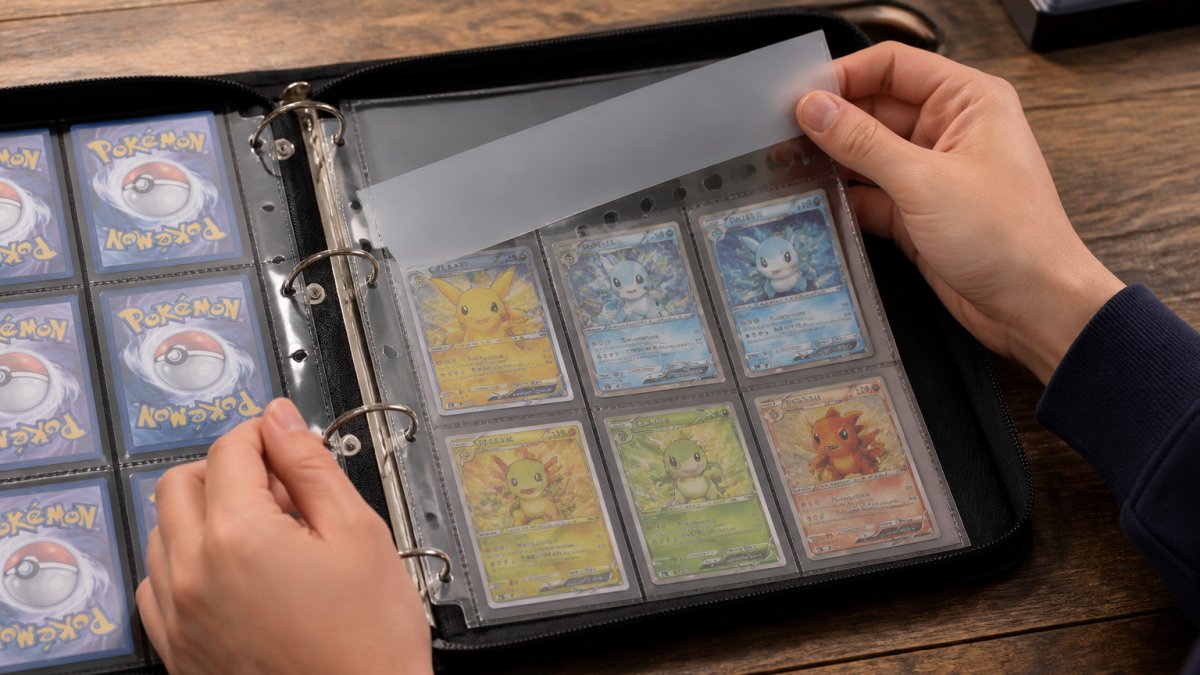
Matching Dividers to Binder and Pocket-Page Sizes
Standard-size cards fit nine-pocket pages, and most dividers are cut for that layout. The variables are the binder itself and the page format.
- Nine-pocket pages: The default. Most dividers are sized for this format.
- Twelve-pocket binders: Smaller pockets, so standard dividers often sit too tall.
- Sixteen-pocket binders: Tight pocket dimensions; check divider width carefully.
Measure the pocket height and the gap between the page top and the binder edge. If the divider is taller than that gap, the binder won't close flat.
Materials, Edge Finish, and Protection
Material choice decides card safety. Rigid plastic dividers with a smooth, rounded edge slide past sleeved cards without snagging; thin cardstock can develop rough cut edges that catch a sleeve and drag the card.
Look for dividers with a deburred or rounded edge. Avoid anything with a sharp die-cut corner. If you're storing foil cards or high-value singles in the same binder, keep the stiffest, smoothest dividers next to them.
Pokémon Card Binder Organization: Sorting by Set and Rarity
Pokémon card binder organization comes down to picking one sorting rule and sticking to it. Mixed systems turn a binder into a mess.
The two workable approaches:
- By set: One divider per set, ordered by release date. Best for set collectors chasing completion.
- By rarity or value: Dividers separating bulk, holos, and high-value cards. Best for investors and traders.
Set organization suits anyone working a full set list, since the divider doubles as a progress marker. Rarity sorting suits competitive players pulling singles fast.
A hybrid works too: sets in the main binder, rarity dividers in a smaller binder for trade stock.
Dividers by Pokémon Set: Covering Current and Older Releases
Set coverage is where most divider products fall short. A pack labeled "all sets" often means recent releases only, leaving Base Set through mid-era sets without a matching divider. Verify coverage by name before buying, using a checklist rather than trusting the label.
Why Set Coverage Breaks Down
Pre-made divider packs are produced in waves that follow current expansion releases, so newer sets are well covered while older and vintage sets are often missing or reduced to generic labels. For collectors working on older releases, that means duplicates for recent sets and gaps for everything older.
A Practical Set-Coverage Checklist
Before buying any divider pack, run through these checks:
- Does the listing name the sets included? A verifiable list beats a generic "all sets" claim every time.
- Does it cover the era you collect? If you collect Base Set through mid-era, confirm those names appear, not just recent expansions.
- Are labels pre-printed or blank? Pre-printed labels save time but lock you into the seller's set list; blank dividers let you fill gaps yourself.
Covering Vintage and Older Sets
For vintage collections, printable dividers are often the only way to get accurate labels for early sets, since pre-made packs rarely cover them fully. Build your label list from a reliable set checklist and print only the sets you actually collect, keeping the binder focused.
Keeping Pace With Current Releases
Current releases are easier. Newer divider packs tend to keep pace with each expansion wave, but confirm the pack includes the latest expansion before buying. If you organize by release date, add new dividers at the back as sets release and reorder only when a new wave arrives.
A workable system for most collectors: physical dividers for well-covered recent sets and printable dividers for vintage or custom sections. That hybrid closes the coverage gap without forcing one format for everything.
Common Mistakes When Buying and Using Card Dividers
The mistakes are predictable, which means they're avoidable.
- Skipping the measurements. Buying before confirming height and width against your pocket pages.
- Ignoring edge finish. Sharp-cut edges snag sleeves and crease cards over time.
- Buying counterfeit-adjacent supplies. If you're wary of fakes in general, learn how to spot fake Pokémon cards so the same scrutiny applies to accessories.
Conclusion
The real challenge isn't finding dividers, it's finding ones that fit your binder, protect your cards, and cover the sets you actually collect.
At Leagueheadquarters, we stock premium TCG supplies built for exactly this job, alongside sealed products, singles, and graded cards from PSA, CGC, and TAG. Browse the supplies range and build a binder that holds up to daily handling.
Frequently Asked Questions
Where can I buy Pokémon card dividers for binders?
You can buy card dividers from online card shops, marketplace sellers, craft stores, and local game stores. Specialty Pokémon retailers often stock dividers sized for standard binders, while marketplaces offer a wider range of custom and printable designs. Check the divider height and tab position against your binder before ordering, and confirm the seller's shipping and return policy so a poor fit is easy to fix.
Are Pokémon card dividers compatible with standard trading card binders?
Most dividers are made to fit standard three-ring binders and nine-pocket pages, but sizes vary. Measure your binder's page height and the width of your pocket columns before buying. A divider that is too tall will bend at the top, and one that is too wide can press against card edges. If you use a 12-pocket or 16-pocket binder, look for dividers made for that layout rather than trimming standard ones.
Can I make my own Pokémon TCG binder dividers?
Yes. Printable divider templates let you print, cut, and label dividers at home, which is cheaper for large collections and lets you match your exact set list. Use cardstock rather than plain paper so the tabs hold their shape, and keep cut edges smooth so they do not catch on sleeves. Printable options take more time and are less durable than plastic dividers, so many collectors use them for sorting first and upgrade later.
What should I look for when choosing custom Pokémon card dividers?
Check four things: fit for your binder size, material thickness, edge finish, and label space. Plastic dividers last longer and resist bending, while cardstock is cheaper and easier to write on. Smooth edges protect sleeved cards from scuffs, and a wide tab gives you room to write the set name and year. If you sort by set, order dividers that cover both current and older releases so you are not left with gaps.
