
How to Spot Fake Pokémon Cards: 7 Signs to Check
Last Updated: October 22, 2026
Quick Summary
You can spot fake Pokémon cards by checking for a pattern of small mismatches in printing, card stock, and text rather than looking for one smoking gun. Compare colors, fonts, spelling, thickness, and holo patterns against a known authentic card from the same set and era. Never bend, wet, or tear a card to test it, since modern fakes often pass those tests and you will damage a real card.
- Skip bend, water, and rip tests because they damage authentic cards and prove nothing reliable.
- Authentic card backs show a deep, rich blue with a clean yellow border.
- Blurry text at small sizes is one of the most reliable signs of a fake.
- Real holo patterns shift color as you tilt the card; printed fakes stay the same shade.
- Confirm the card name, set symbol, set number, and rarity in the official card database.
Table of Contents
- How to Spot Fake Pokémon Cards: Start With a Safe Inspection
- The Most Common Fake Pokémon Card Signs
- How to Run a Pokémon Card Texture Test
- Using a Pokémon Card Light Test the Right Way
- Checking Holographic Foil, Symbols, and Set Details
- What to Do With Fake Pokémon Cards Once You Find One
- How to Verify a Card Before You Buy
- Frequently Asked Questions
How to Spot Fake Pokémon Cards: Start With a Safe Inspection
Fake Pokémon cards flood online marketplaces and card shows every year, and most buyers only notice after the money is gone. This guide from Leagueheadquarters walks you through how to spot fake Pokémon cards using a safe, non-destructive inspection you can run in minutes, with no chemicals and no damage to the card.
Here is the core idea: you are not looking for one smoking gun. You are looking for a pattern of small mismatches.
Why a Non-Destructive Checklist Beats Risky Tests
Risky tests destroy evidence and value. A bend test, a water test, or a rip test tells you almost nothing reliable, and it ruins a real card in the process. Skip them all.
A careful visual and tactile inspection is safer and more accurate. Counterfeiters copy artwork well these days. They slip up on print quality, card stock, and small text details.
That is where your checklist wins.
The Most Common Fake Pokémon Card Signs
The clearest fake Pokémon card signs show up in printing. Counterfeiters nail the big picture and miss the small stuff: colors, fonts, borders, and card stock.
Here is the short version of what to check:
Sign |
What to Look For |
Why It Matters |
|---|---|---|
Color and saturation |
Washed out or oversaturated ink |
Cheap printers miss color balance |
Card back |
Darker blue, fuzzy border |
Backs are hard to copy well |
Fonts |
Wrong typeface, odd spacing |
Custom fonts are expensive to match |
Spelling |
Typos in names or attack text |
Common on budget fakes |
Thickness |
Too thin or too glossy |
Different card stock |
Holo pattern |
Flat, uniform shine |
Real foil shifts with angle |
Symbols |
Blurry energy or set symbols |
Low print resolution |
Colors, Borders, and Card Backs
Start with the card back. Flip it over and study the blue border and the Poké Ball design.
An authentic card back has a deep, rich blue with a clean yellow border. Fakes often look lighter, washed out, or slightly gray.
Now check the front colors. Real cards show strong color saturation and balance.
Hold two cards side by side if you can.
Fonts, Spelling, and Text Alignment
Look closely at the card name, attack text, and rules box. Real cards use a specific custom font, and counterfeiters rarely match it.
Check these details:
- Is the card name in the right typeface?
- Are the attack text and damage numbers aligned cleanly?
- Any spelling errors in the name, attacks, or flavor text?
Blurry text is one of the most reliable signs. Real printing is sharp. Cheap fakes smear at small sizes.
How to Run a Pokémon Card Texture Test
A Pokémon card texture test checks how the card feels and how light plays across its surface. Real cards have a faint, consistent grain and a matte finish. Fakes often feel slick, too smooth, or slightly waxy.
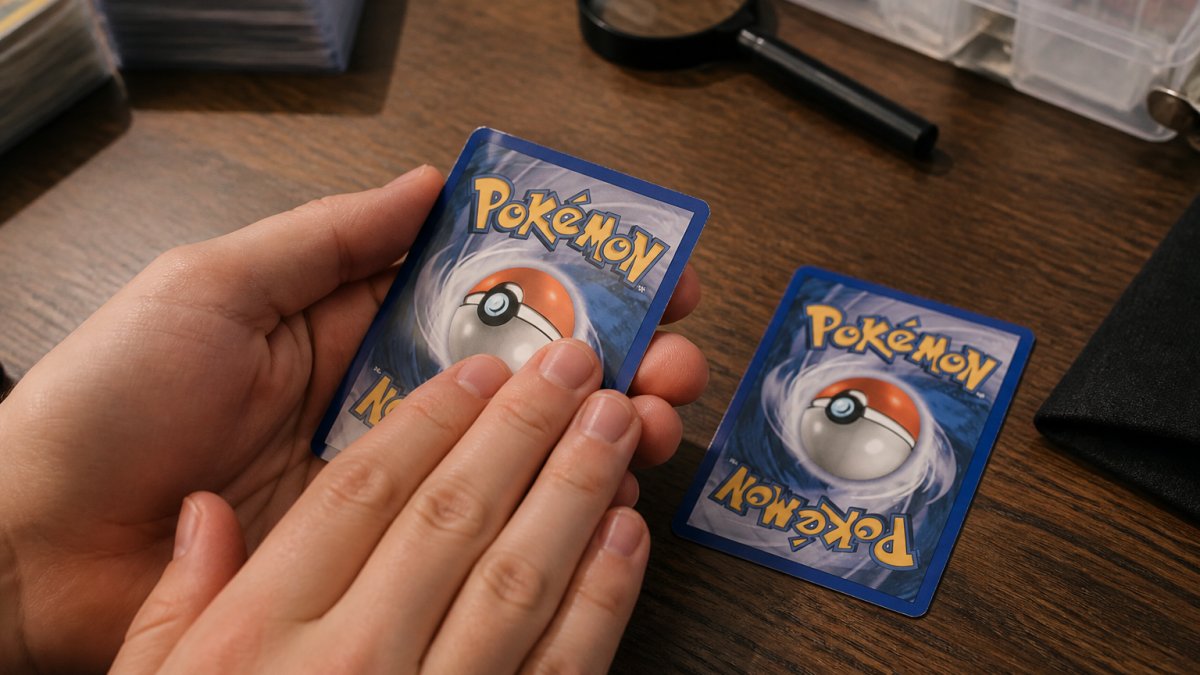
Run your fingertip lightly across the surface. You should feel a subtle grain, not glass. Tilt the card under a lamp and watch the reflection. Real card stock scatters light softly.
Why Texture Varies by Era and Print Run
A common false alarm is judging an older card against a modern one. Texture and stiffness have changed across eras and print runs. Early cards tend to feel slightly different from modern cards, and cards printed in different languages or regions can vary in stock and finish. Always compare against a known authentic card from the same set, language, and approximate print run.
A Safe, Non-Destructive Texture Checklist
Use these checks in order, and stop if anything feels off:
- Run a fingertip lightly across the surface: subtle grain, not glass or wax.
- Tilt under a single light source: soft scatter, not a uniform sheen.
- Hold by one corner and let it flex slightly: firm and springy, not flimsy or rigid.
tip Texture is supporting evidence, not proof. Counterfeit quality varies, and no single clue, including feel, proves a card is fake. Use texture together with print, color, and official reference checks.
Using a Pokémon Card Light Test the Right Way
The Pokémon card light test uses a bright lamp or phone flashlight to reveal print layers and foil quality.
Real cards block light fairly evenly. Very thin fakes may glow or look translucent. Tilt the card slowly and watch the foil.
A real holographic card shifts color as the angle changes. The pattern moves and shimmers. Fake foil tends to look flat, printed, or static, with no depth.
Checking Holographic Foil, Symbols, and Set Details
Holographic and foil details are where many fakes fall apart, but they are also where false alarms happen.
Real holofoil has depth and a fine pattern. Fakes often show a coarse, uniform grid or a sticker-like shine. The holo stamp on modern cards should sit cleanly with sharp edges. Tilt the card slowly under a single light source and watch the pattern shift.
Then check the small symbols:
- Energy symbols should be crisp and correctly shaped.
- The set symbol should match the set and era.
- The set number and rarity symbol should line up with official set lists.
How to Verify Against Official References
Use The Pokémon Company's official card database to confirm the card name, set, set number, and rarity. Compare the artwork crop, attack wording, and text alignment against official images. This is the single best reference for verifying card authenticity because it shows what the card is supposed to look like, not what a seller claims.
A practical workflow:
- Note the card name, set symbol, set number, and rarity from the card.
- Look up the card in the official database and confirm all four match.
- Compare the artwork crop and attack text against the official image.
- Check the holo pattern and stamp against known authentic examples from the same set.
- If anything does not match, treat it as a red flag and gather more evidence before buying or selling.
Counterfeit Variations and Limits of Individual Tests
Counterfeit quality varies widely. Some fakes fail obvious checks like spelling or color; others copy artwork well and only slip up on foil depth or card stock. No single clue, color, feel, foil, or symbols, proves a card is fake. Use a pattern of mismatches, and confirm against official references before drawing conclusions.
Avoiding False Alarms from Legitimate Variations
Legitimate cards vary by era, language, and printing. Foil patterns, card stock, and even symbol rendering can differ between releases and regions. Before calling a card fake, confirm that the variation is not a known legitimate difference. Compare against a known authentic card from the same set, language, and print run, and check the official database for that specific release.
What to Do With Fake Pokémon Cards Once You Find One
What to do with fake Pokémon cards depends on where you got them. If you bought from a retailer or marketplace, act fast and keep your evidence.
Follow these steps:
- Stop using the card and set it aside in a sleeve.
- Photograph the card front and back in good light.
- Save the listing, receipt, and any messages with the seller.
- Contact the seller and request a refund.
- If they refuse, open a dispute with your payment provider or the marketplace.
- Report the listing so other buyers are protected.
Do not try to resell a card you believe is fake. Passing it on hurts other collectors and can break marketplace rules.
The best protection is prevention. Buy from sellers who show clear, high-resolution photos and who stand behind authenticity. At Leagueheadquarters, we offer a curated array of rare graded cards from PSA, CGC, and TAG.
How to Verify a Card Before You Buy
Verification before purchase beats inspection after. Ask the seller for clear photos of the front, back, edges, and holo under different light.
Use this pre-purchase checklist:
- Clear, high-resolution photos of front and back
- Close-up of the holo pattern and any stamp
- Card name, set symbol, and set number visible
For graded cards, check the certification number against the grader's official lookup.
Counterfeiters also target sealed products.
This is where buying from a specialist helps. Leagueheadquarters was founded by lifelong Pokémon fans, and we stock sealed products, TCG singles, and premium supplies alongside curated graded cards from PSA, CGC, and TAG.
If you are new to collecting, start with raw singles and learn the feel of real card stock before spending big on grails.
Frequently Asked Questions
What are the easiest ways to spot fake Pokémon cards?
Start with the fastest checks: compare the card back's blue border and print quality against a known authentic card, look for blurry text or misspelled words, and feel the surface. Real cards have a fine, slightly rough texture from the print layers, while many fakes feel glossy or slick. A light test and a close look at the holographic foil confirm what the first checks suggest. No single sign proves a card is fake, so stack several checks before deciding.
Can you tell if a Pokémon card is fake by its texture?
Often, yes. A Pokémon card texture test works because genuine cards are printed in layers that leave a subtle grain you can feel with a fingertip. Counterfeits are usually smoother, glossier, or oddly bumpy. Run your finger lightly across the artwork and the border, then do the same on a card you know is real. The difference is usually obvious once you have a reference point. Texture alone is not conclusive, so pair it with color, font, and light checks.
Are Pokémon cards with spelling mistakes always fake?
No. Genuine Pokémon cards have shipped with occasional typos and misprints over the years, and some of those errors are collectible. That said, spelling mistakes are one of the most common fake Pokémon card signs, especially when combined with blurry fonts, misaligned text, or wrong energy symbols. Check whether the error appears on an official reference for that set, and treat a typo as one clue among several rather than proof on its own.
What should I do with fake Pokémon cards after I confirm one?
Stop the transaction if you have not paid, and contact the seller for a refund if you have. Keep photos of the card and the listing as evidence. Do not resell it or trade it as real, and do not send it to a grading company. If you bought from a marketplace, open a dispute through its resolution process. For prevention, buy from sellers who show clear close-up photos and offer returns, and verify graded cards through the grader's own lookup before paying.
Fake cards are getting better, and no single test catches them all. The winning approach is a calm, non-destructive checklist: compare colors, fonts, texture, and foil against official references, and verify before you pay. When you want cards you can trust, Leagueheadquarters offers graded cards from PSA, CGC, and TAG, premium protection supplies, and a community of collectors who care about authenticity. Get started with Leagueheadquarters and build a collection you never have to second-guess.